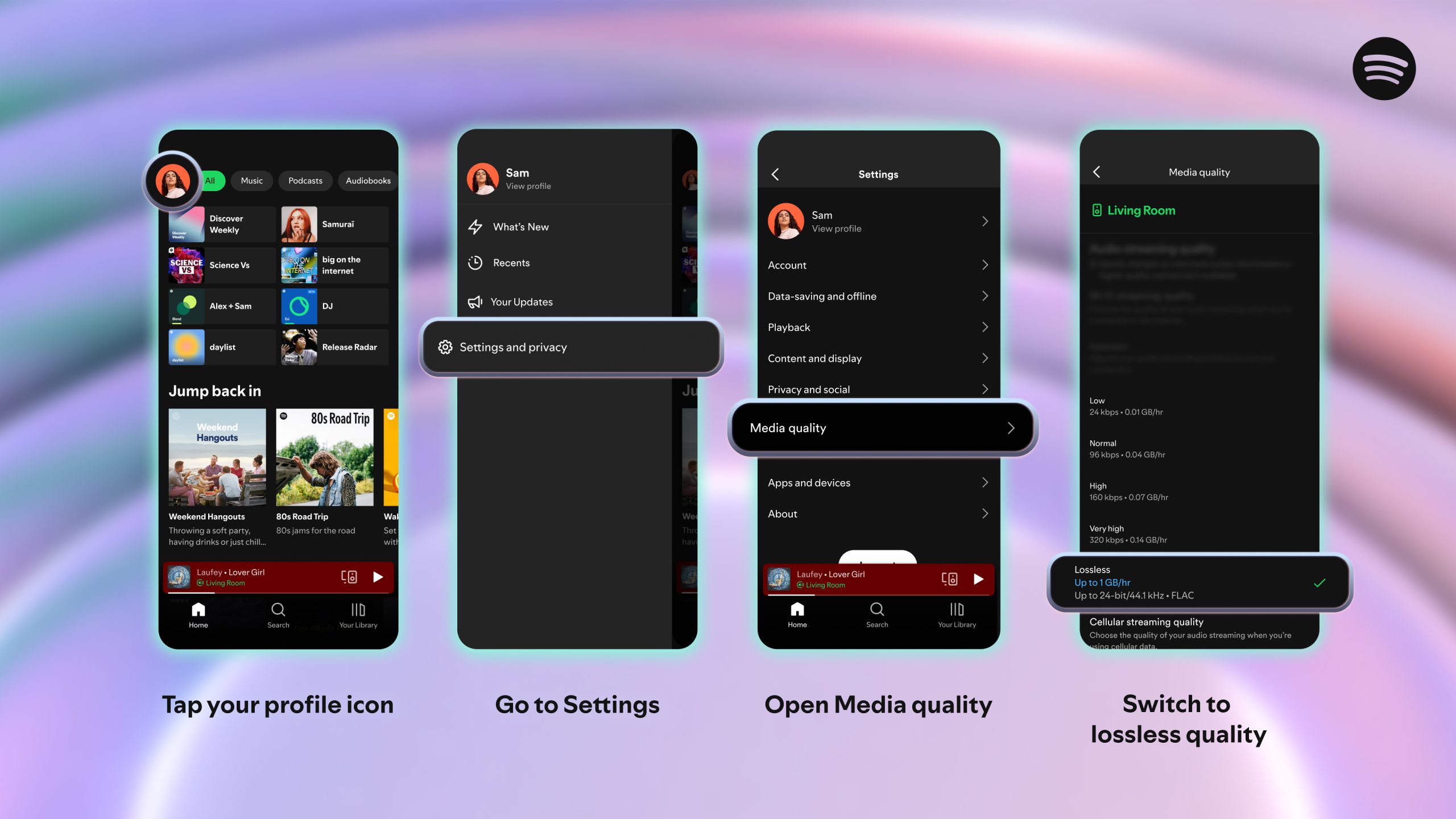
Spotify has officially begun rolling out its long-awaited lossless audio feature for Premium subscribers, bringing higher quality music streaming to millions of users. The feature, known informally as Spotify HiFi during its early development, enables playback in up to 24-bit/44.1kHz FLAC format. This marks a major shift for the world’s largest music streaming service, which until now capped audio quality at 320kbps Ogg Vorbis.
The launch is initially available in twelve countries including the United States, the United Kingdom, Germany, Japan, Sweden, Australia, and several European markets. Spotify has confirmed that the rollout will expand gradually to more than 50 markets through October. Premium subscribers in eligible regions will notice a new Lossless option in their media quality settings, which can be activated separately for Wi-Fi streaming, mobile data, and downloads.
The move comes after years of speculation and delays. Spotify first revealed its intention to introduce HiFi audio in 2021, a period when most competitors charged extra for lossless or high-resolution streaming. However, Apple disrupted the market by offering lossless and spatial audio at no additional cost, prompting Spotify to put its plans on hold. Since then, rivals including Apple Music, Tidal, Amazon Music, and Qobuz have advanced with both high-resolution streaming up to 24-bit/192kHz and immersive spatial audio catalogs, leaving Spotify under pressure to match expectations.
By delivering FLAC-based lossless audio at 24-bit/44.1kHz, Spotify provides a noticeable improvement for users with high-quality headphones, speakers, or home audio systems. However, the offering still lags behind competitors in terms of technical specifications. Services like Tidal and Apple Music support higher sample rates and resolution, alongside Dolby Atmos and other spatial formats, which remain absent from Spotify’s platform. This disparity has raised questions about whether Spotify is preparing to launch additional premium tiers in the future to include high-resolution or spatial content.
Despite these limitations, the addition of lossless audio is a significant upgrade for Spotify Premium, particularly given that it is included in the existing subscription price. Users who prioritize sound fidelity can now enjoy more detail and clarity in their music library without having to switch to competing platforms. The new feature supports playback across mobile, desktop, and tablet applications, and is also compatible with many Spotify Connect-enabled devices from brands such as Sony, Bose, Samsung, and Sennheiser. Wider device support, including Sonos and Amazon hardware, is scheduled to follow.
Spotify advises users that lossless streaming requires more bandwidth and storage than compressed formats, which can lead to larger file sizes and longer initial loading times. Wired headphones or non-Bluetooth connections are recommended for the best experience, as Bluetooth technology cannot yet transmit full lossless audio without compression.