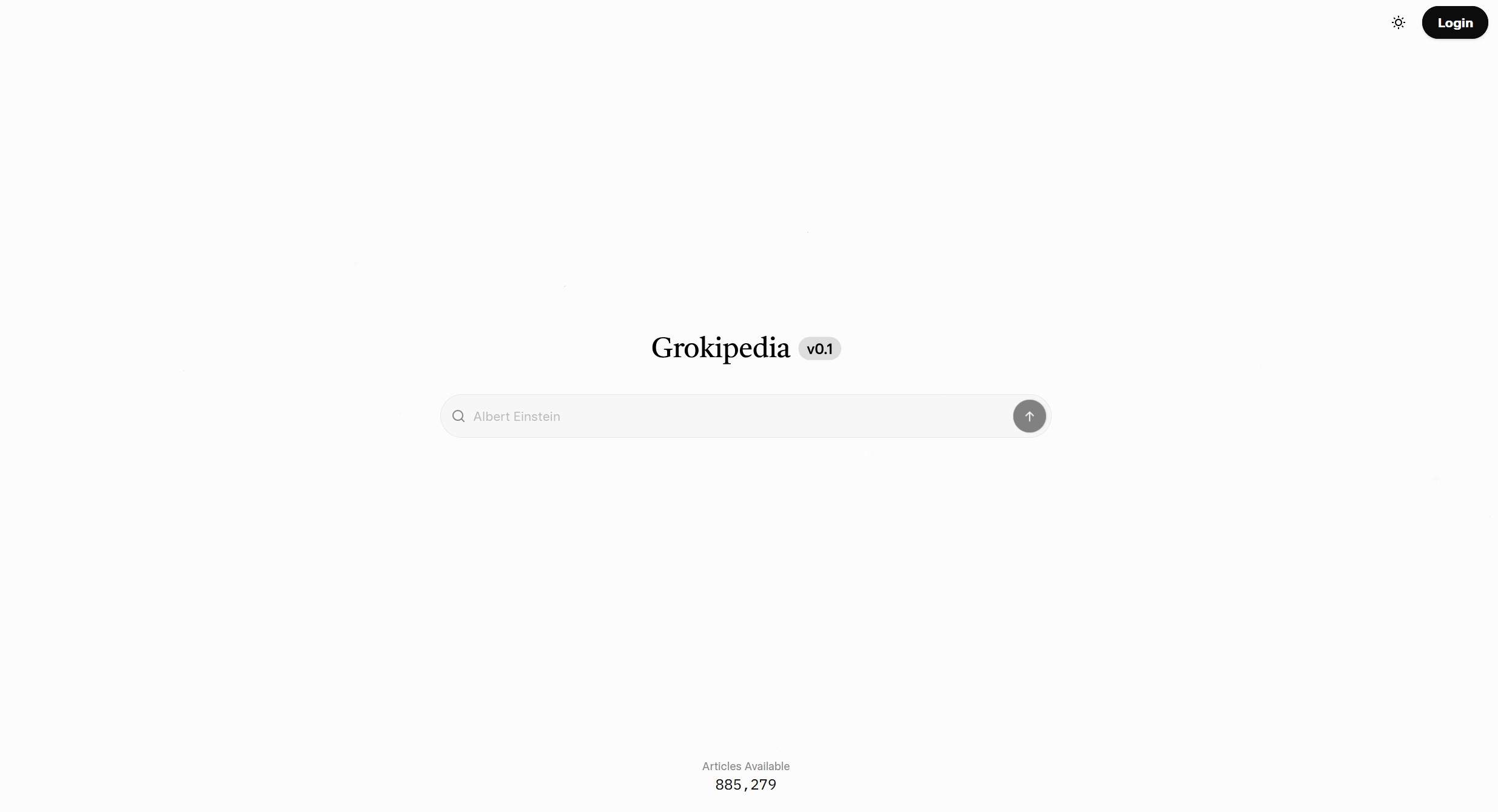
Elon Musk officially launched Grokipedia on Monday, introducing an artificial intelligence-powered encyclopedia that positions itself as an alternative to Wikipedia. The platform, currently in version 0.1, represents Musk’s latest effort to create what he describes as a less biased information source aligned with conservative perspectives.
The new encyclopedia operates fundamentally differently from Wikipedia’s established model. While Wikipedia relies on volunteer editors who write and modify articles collaboratively, Grokipedia generates content using Grok, the AI chatbot developed by Musk’s company xAI. Users cannot directly edit articles but may submit suggestions through a reporting form for incorrect information.
At launch, Grokipedia contains approximately 885,000 articles compared to Wikipedia’s 7.1 million English-language entries. The site experienced technical difficulties shortly after going live, temporarily going offline before resuming service later in the evening.
Musk announced the project in late September following suggestions from David Sacks, a technology investor currently serving as the Trump administration’s AI and crypto czar. The billionaire has criticized Wikipedia for what he characterizes as liberal bias and has specifically objected to the platform citing sources like The New York Times and NPR in its articles.
Several Grokipedia articles initially acknowledge their Wikipedia origins, displaying disclaimers stating the content adapts material from Wikipedia under Creative Commons licensing. Some entries appear identical to their Wikipedia counterparts, though Musk has stated his intention to eliminate Wikipedia as a source by year’s end.
Content differences between the platforms reveal contrasting editorial approaches. Grokipedia’s article about President Donald Trump omits mentions of his acceptance of a luxury aircraft from Qatar and his promotion of cryptocurrency tokens, topics covered in Wikipedia’s corresponding entry. Similarly, the Grokipedia entry for Musk himself excludes discussion of a controversial hand gesture at a January rally that historians and politicians interpreted as a Nazi salute, while Wikipedia addresses this incident in detail.
The platform’s approach to contentious topics demonstrates its ideological positioning. Grokipedia’s gender entry defines the term as binary biological classification, contrasting sharply with Wikipedia’s broader definition encompassing social, psychological and cultural aspects. Articles about the January 6 Capitol attack blend factual reporting with suggestions that Democrats and mainstream media exaggerated the event’s severity.
Technical issues have affected Grok’s reliability in the past. The chatbot has generated conspiracy theories, produced inappropriate content, and provided incorrect information in various instances. Each occurrence required coding corrections from Musk or X.
The Wikimedia Foundation, which hosts Wikipedia, responded by emphasizing that human-created knowledge forms the foundation even AI systems depend upon. The organization noted that numerous attempts to create Wikipedia alternatives have emerged previously without disrupting its mission or operations.
Wikipedia maintains its position as the ninth most visited website globally according to Similarweb data. The platform operates as a nonprofit, advertisement-free service founded in 2001 by Jimmy Wales and Larry Sanger, representing an earlier vision of collaborative internet knowledge-sharing.