Qualcomm has announced a major strategic expansion into the artificial intelligence data center market with the unveiling of two new accelerator chips, the AI200 and AI250. This move positions the company as a new competitor to Nvidia, which has largely dominated the market for AI semiconductors.
The announcement was met with strong investor enthusiasm, causing the company’s stock to rise significantly as it signaled a serious effort to capture a share of the rapidly growing AI infrastructure industry. This initiative is a key part of Qualcomm’s broader strategy to diversify its business beyond the smartphone chip market, which has historically accounted for the majority of its sales. The company has faced challenges in the mobile sector, including the loss of major customers and increased competition, prompting its recent expansion into markets such as personal computer processors and now, high-performance data center AI.
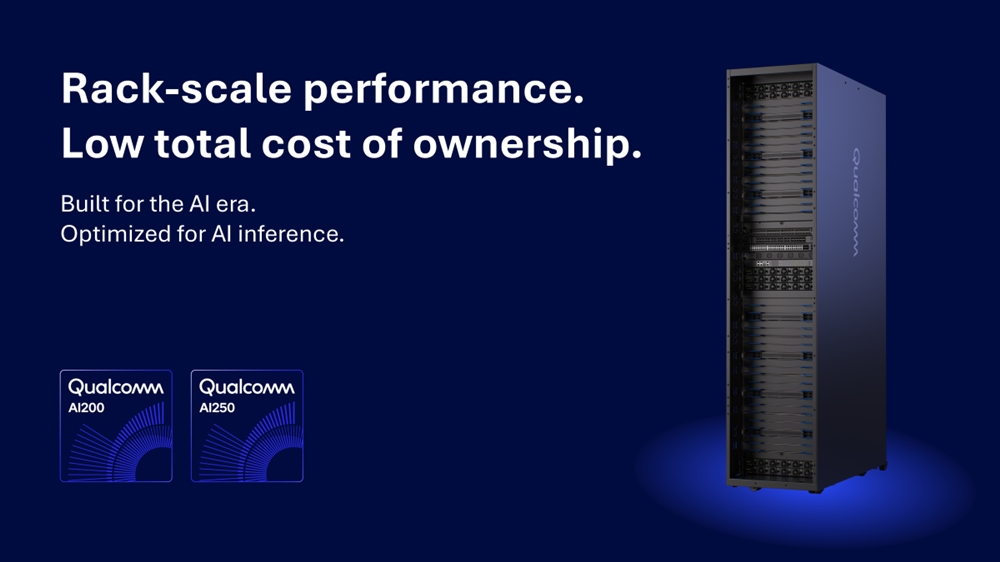
The new chips are purpose-built for AI inference, which is the process of running already trained AI models to generate results. By focusing specifically on inference rather than the energy-intensive training phase, Qualcomm aims to deliver solutions with superior performance per dollar and per watt. This approach leverages the company’s extensive experience in designing efficient, low-power Neural Processing Units, or NPUs, for its Snapdragon mobile chips.
The technology from its Hexagon NPUs has been scaled up to meet the demands of data centers. The AI200, set to be commercially available in 2026, is designed to handle large and complex AI models with high memory capacity, supporting up to 768 GB of LPDDR memory per card. This feature is intended to deliver fast performance for large language and multimodal models with low latency.
The subsequent chip, the AI250, is planned for release in 2027 and is expected to provide a generational improvement in efficiency. It will feature an innovative memory architecture that delivers substantially higher effective memory bandwidth while consuming much less power.
In addition to selling individual accelerator cards, Qualcomm will offer complete, rack-scale solutions. These systems will be directly liquid-cooled for thermal efficiency and can integrate up to 72 chips to function as a single, powerful computer, a model similar to the full-system offerings from competitors Nvidia and AMD. These racks are engineered for scalability, using PCIe for internal expansion and Ethernet for scaling out across multiple racks. The company has also committed to an annual release cadence for its data center products moving forward.
To ensure immediate market relevance, Qualcomm has secured a significant launch customer for its new technology. Humain, an AI startup financially supported by Saudi Arabia’s sovereign wealth fund, will begin deploying 200 megawatts of data center racks powered by the AI200 chip starting in 2026.
This early adoption provides crucial validation for Qualcomm’s new venture and may persuade other enterprises to consider its hardware as a viable alternative to supply-constrained options from established players. While entering a market with a dominant leader like Nvidia presents challenges due to high switching costs, industry analysts suggest the global demand for efficient AI compute is large enough to support multiple providers. To facilitate adoption, Qualcomm is providing a comprehensive software stack that supports leading AI frameworks and tools, enabling developers to easily integrate and deploy models from platforms like Hugging Face.