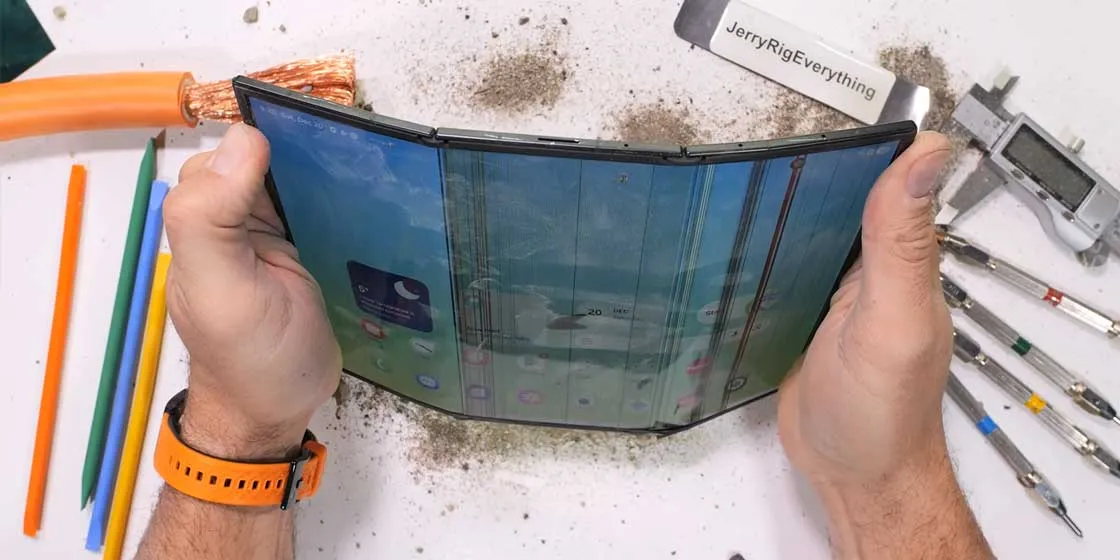
The Samsung Galaxy Z TriFold has become the first Samsung foldable device to fail a major structural durability test. The device, which unfolds into a 10-inch tablet through a dual-hinge mechanism, snapped when subjected to bending pressure applied in the opposite direction of its intended folding motion. This marks a significant departure from previous Samsung foldables like the Galaxy Z Fold 7, which successfully withstood similar testing procedures.
The primary weakness lies in the device’s ultrathin construction. At just 3.9mm thick when fully unfolded, the chassis leaves minimal room for internal structural reinforcement. During testing, backward pressure caused the frame to buckle almost immediately. The hinges shifted out of alignment, and the display suffered permanent damage with pixels tearing and sections going completely dark. The device was rendered essentially unusable after the structural failure.
Material vulnerabilities extend beyond the frame itself. The inner flexible screen uses a plastic-based panel that scratches at level 2 on the Mohs hardness scale, making it susceptible to permanent damage from everyday items like fingernails, keys, or coins. The outer display performs better, scratching at level 6 with deeper grooves at level 7, which is standard for glass displays. However, the rear panels consist of fiberglass rather than metal or glass, which scratches more easily than materials typically used on premium smartphones.
Debris poses another significant challenge for the device. Testing with dirt and sand revealed that particles easily infiltrate the hinge mechanism, causing audible grinding and crunching sounds during operation. This suggests that owners will need to exercise greater care in dusty or sandy environments compared to traditional foldables.
Internal examination revealed additional design compromises. The device contains three separate batteries spread across its three folding segments, totaling 5,600 mAh capacity. However, the battery removal process exposed a potential safety concern where the pull tabs caused the thin battery cells to bend, which could present dangers if not handled properly. The teardown also showed no thermal paste or specialized cooling hardware inside, indicating the manufacturer relies entirely on the thin aluminum frame for heat dissipation.
Despite these test results, Samsung maintains that the hinge mechanism can withstand up to 200,000 folds under normal usage conditions. This would theoretically provide approximately five years of use if the device is folded and unfolded 100 times daily. The device also includes built-in sensors that detect incorrect folding attempts, vibrating and displaying warning messages to prevent users from accidentally folding it the wrong way.
The Galaxy Z TriFold is expected to launch globally in early 2026. While the durability test results highlight genuine structural limitations, they represent extreme stress scenarios that exceed typical daily usage. The device requires careful handling and protection from both physical stress and environmental debris to maintain functionality over its intended lifespan.
The device features a 10-inch LTPO OLED main display with 120Hz refresh rate and 1600 nits peak brightness when fully unfolded, alongside a 6.5-inch cover display with 120Hz and 2600 nits peak brightness. It runs on the Snapdragon 8 Elite processor with 16GB of RAM and storage options of either 512GB or 1TB. The camera system includes a 200MP main sensor, a 12MP ultrawide lens, and a 10MP telephoto camera with 3x optical zoom. The device supports 45W wired charging for its 5,600 mAh battery and comes with Android 16. Samsung announced the Galaxy Z TriFold in December 2025, with availability beginning in South Korea on December 12, 2025, and a global release planned for early 2026.