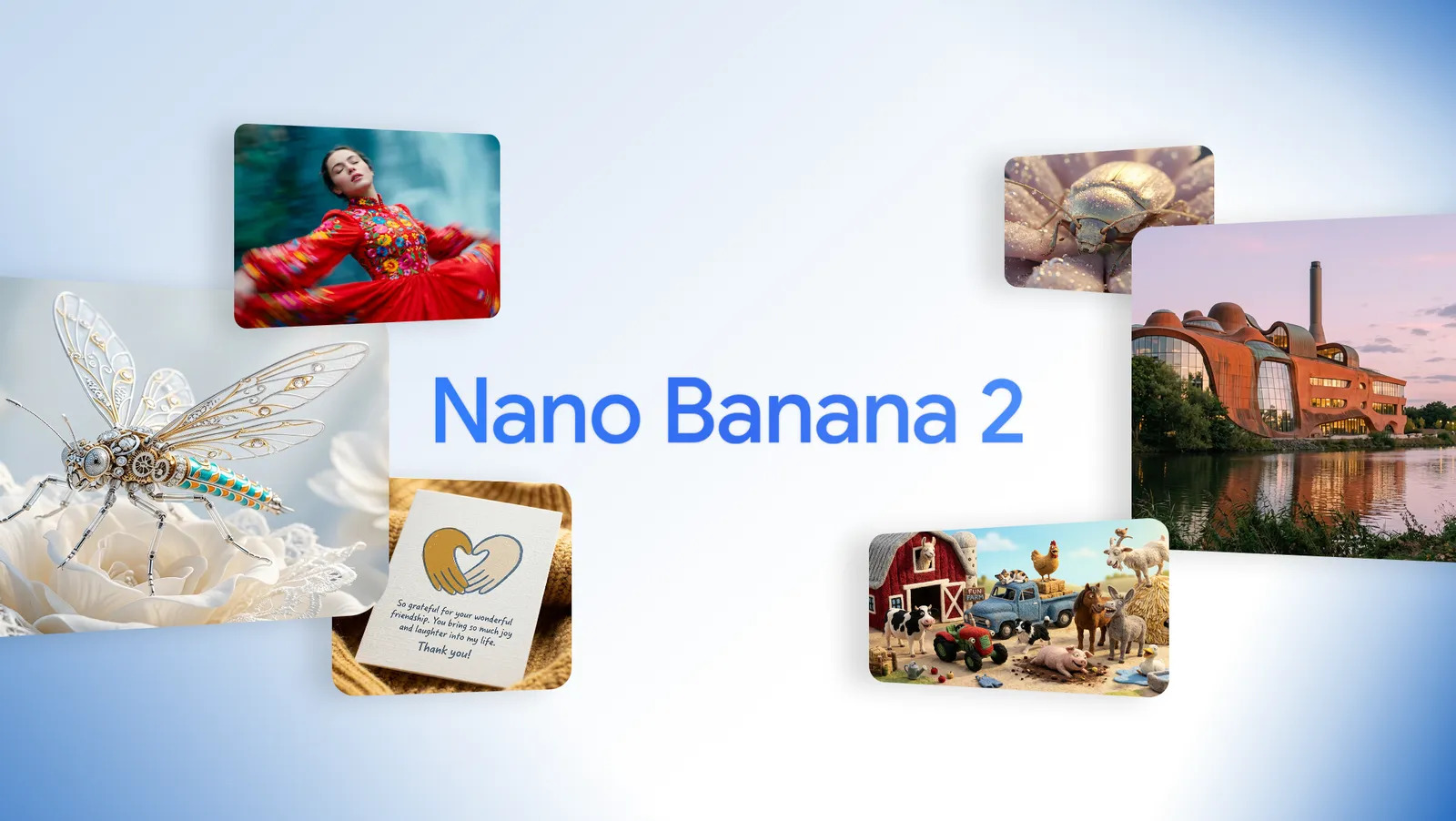
Google has launched Nano Banana 2, its latest AI image generation and editing model, making it available across Gemini, Google Search, AI Studio, Google Cloud, Flow, and Google Ads. The model is officially designated as Gemini 3.1 Flash Image and replaces the original Nano Banana as the default image tool across Google products.
The new model combines the advanced capabilities of Nano Banana Pro with the generation speed of Gemini Flash. It draws from Gemini’s real-world knowledge base and integrates real-time web search data to produce more accurate and contextually grounded images. This allows the model to generate infographics, data visualizations, and diagrams from live information rather than static training data alone.
Nano Banana 2 supports precise text rendering within images, enabling use cases such as marketing mockups, greeting cards, and localized signage across multiple languages. The model maintains subject consistency for up to five characters and up to 14 objects within a single workflow, making it suitable for storyboarding and sequential visual narratives.
Image output resolution now spans from 512 pixels up to 4K, with support for multiple aspect ratios. Google describes the visual quality as delivering vibrant lighting, richer textures, and sharper details compared to the original Nano Banana model. These production-ready specifications make the tool applicable to professional advertising and content creation workflows.
The original Nano Banana launched in August last year and quickly gained widespread adoption for its ability to edit photos of real people in photorealistic ways. Nano Banana Pro followed three months later with stronger text generation and higher visual fidelity. Nano Banana 2 now positions itself as the standard-tier model while Nano Banana Pro remains available to Google AI Pro and Ultra subscribers for specialized, high-fidelity tasks.
Google Ads now uses Nano Banana 2 to power image suggestions during campaign creation. In the Gemini app, the model is the new default across Fast, Thinking, and Pro tiers. It is also accessible through Google’s Flow video tool at no credit cost to users, and is available in preview via Vertex AI on Google Cloud.
Hands-on testing by independent reviewers has shown the model produces convincing photorealistic edits and detailed scene compositions, though some generations involving human faces and real-time data accuracy have shown inconsistencies. In one test, the model pulled outdated weather data before correcting itself when prompted. Face compositing in complex action scenes also produced noticeable artifacting.
To address growing concerns about AI-generated misinformation, Google has embedded SynthID invisible watermarks into all Nano Banana 2 outputs. The company is also coupling this with C2PA Content Credentials, an interoperable industry standard that records how and where AI was used in content creation. Since its November launch, the SynthID verification feature in the Gemini app has been used over 20 million times. Google has announced plans to bring C2PA verification directly into the Gemini app in the near future.
The release arrives as AI-generated content continues to present challenges across digital platforms. A recent survey found that while the vast majority of social media users report seeing AI-generated posts, fewer than half feel confident they can identify them. Tools like Nano Banana 2, which are free and widely accessible, accelerate the pace at which photorealistic fabricated images can be produced and distributed online.