Baidu Launches M100 and M300 AI Chips in China
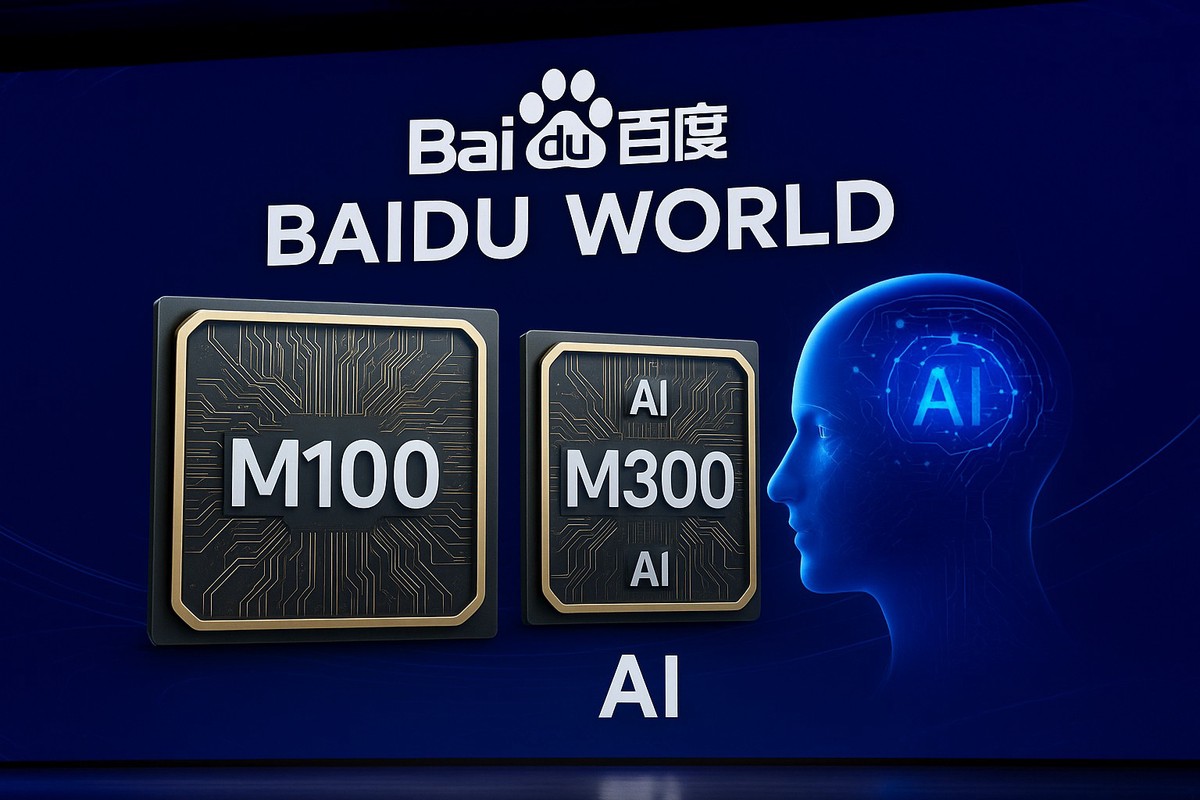
Baidu unveiled two new artificial intelligence processors at its World Conference 2025 on November 13, marking a significant advancement in China’s push toward technological independence in the semiconductor sector. The announcement comes as escalating tensions between the United States and China have led to restrictions on exports of advanced American AI chips to Chinese companies.
The company introduced the M100 and M300 chips, both developed by its Kunlunxin Technology division. Shen Dou, executive vice president at Baidu and president of its cloud unit, stated the new processors would provide powerful, low-cost and domestically controlled computing power to support Chinese firms seeking alternatives to imported chips.
The M100 chip is optimized for large-scale inference operations, particularly for models using the mixture-of-experts technique. This processor leverages Baidu’s proprietary architecture to significantly enhance inference efficiency in advanced language models. The company plans to launch the M100 in early 2026.
The M300 is designed for both training and inference of ultra-large-scale multimodal models with trillions of parameters. This more powerful chip targets massive AI workloads and extensive expansion capabilities. Baidu expects to release the M300 in early 2027. The company also announced plans for an N-series chip lineup scheduled for 2029.
Alongside the chip announcements, Baidu revealed its Tianchi supernode products, which link multiple processors through advanced networking capabilities to compensate for limitations in individual chip performance. The Tianchi 256 supernode will cluster 256 Kunlun chips and is set for release in the first half of 2026. This configuration features interconnect bandwidth four times higher than Baidu’s previous supernode released in April 2025, with performance improvements exceeding 50 percent.
The Tianchi 512, an upgraded version integrating 512 chips, will launch in the second half of 2026. A single Tianchi 512 supernode can complete training for models with trillion-scale parameters. Baidu’s internally deployed Kunlun supernode technology can boost single-card performance by 95 percent and increase single-instance inference performance by up to eight times.
The company plans to introduce thousand-card-scale supernodes in 2028 based on its new M-series chips. By 2030, Baidu aims to achieve a deployment of one million Kunlun chips in a single cluster on its Baige AI computing platform, creating a massive supernode infrastructure.
Baidu has already deployed tens of thousands of Kunlun chips, which serve as a key foundation in the company’s computing technology stack. Through its Kunlun chips and Baige AI computing platform, Baidu Intelligent Cloud provides high-performance and scalable AI computing power to numerous enterprises. The company has maintained the top position in China’s AI cloud services market for six consecutive years.
The Kunlun chip recently achieved a significant milestone when AI servers powered by these processors won the largest share in China Mobile’s centralized procurement project for artificial intelligence computing equipment in the CUDA-like ecosystem category for 2025 to 2026. This success demonstrates growing industry and market confidence in domestic AI chip solutions.
Baidu also introduced ERNIE 5.0, a multimodal AI model with 2.4 trillion parameters. The model is twice the size of recent releases from Alibaba and Moonshot AI, both of which exceed one trillion parameters and rank among the world’s leading AI systems. Wang Haifeng, Baidu’s chief technology officer, highlighted ERNIE 5.0’s multimodal, coding and agent capabilities. The model integrates diverse training data including audio, images and video, enabling unified understanding and generation of multimedia content.
Robin Li, founder and CEO of Baidu, criticized the current AI industry structure as unhealthy due to its disproportionate rewards for chip developers and foundational model creators. He advocated for a reverted industry pyramid that prioritizes AI applications over models and chips, allowing for greater revenue generation. Li emphasized that Baidu is focusing on integrating AI into corporate and individual services.
One notable application is Baidu’s robotaxi service, which processes 250,000 orders weekly and has provided 17 million rides globally. Li also noted that approximately half of new software code produced at Baidu is now generated by its AI coding platform, Baidu Comate, though he aims to increase this to 80 or 90 percent.
The announcement positions Baidu alongside other major Chinese technology firms pursuing semiconductor independence. Huawei revealed a multi-year roadmap for its Ascend AI chips in September 2025, with planned releases including the Ascend 950PR in first quarter 2026, the 950DT in fourth quarter 2026, the Ascend 960 in fourth quarter 2027, and the Ascend 970 in fourth quarter 2028. The 950 series will feature Huawei’s in-house high bandwidth memory technology.
Other Chinese companies developing AI processors include Cambricon Technologies, MetaX Integrated Circuits and Biren Technology. These domestic chips aim to reduce China’s dependence on imported advanced processors from companies such as Nvidia, whose products face export restrictions to Chinese firms.
Baidu’s shares in Hong Kong closed down less than one percent on the day of the announcement. The company began developing proprietary chips in 2011 and spun off the business into independent firm Kunlunxin Technology in 2021. Baidu currently holds a 59.45 percent stake in Kunlunxin.